
When OpenAI launched ChatGPT Images 2.5 in developer environments, it introduced two distinct model variants: GPT-Image-2.5 Flare and GPT-Image-2.5 Sunburst.
Official documentation describes Flare as a speed-optimized model and Sunburst as an engine built for fine detail and artistic fidelity. Because high-level claims rarely reflect daily production realities, we ran hands-on benchmark tests inside the OpenAI API to observe how both engines interpret identical fine art prompts across multiple runs.
Before reviewing our test data, three operational baseline facts should be noted:
First, this model choice is primarily exposed in developer environments via the OpenAI API. Standard ChatGPT web users interact with an automated routing layer behind the scenes.
Second, both models share identical API pricing: text inputs cost $5.00 per million tokens ($1.25 cached), image inputs cost $8.00 per million tokens ($2.00 cached), and outputs cost $30.00 per million tokens. Flare is not a discounted tier, nor is Sunburst billed as a premium upgrade.
Third, OpenAI positions Flare for up to 50 percent lower latency, while framing Sunburst as the preferred choice for detailed single images and iterative multi-turn editing.
Because both engines cost the exact same amount, we set out to answer a practical production question: does Sunburst deliver noticeably higher visual fidelity, or do the two models simply operate with different stylistic biases?
Test design: Hands-on testing across repeated runs
To eliminate single-seed randomness, we did not rely on one-off outputs. We executed each prompt four consecutive times across both models, checking whether specific rendering traits persisted across independent generations.
We tested two demanding fine art scenarios designed to evaluate material texture, compositional depth, and color handling.
Test prompts
Prompt 1: Surrealist graphic art exhibition poster
A fine art exhibition poster blending surrealism and modern architectural abstraction. In the center, a sculptural travertine stone monolith floats weightlessly above a smooth reflective water surface, surrounded by delicate dried desert botanicals and a minimalist brass geometric ring. The background features warm terracotta and deep indigo color blocks with subtle tactile handmade paper texture and soft morning gallery lighting. Clean composition, fine art print aesthetics, museum exhibition framing, high-end editorial layout.Prompt 2: Atmospheric romanticism oil landscape
A dramatic and poetic fine art oil painting of a rugged coastal basalt cliff during a severe dawn thunderstorm. Thick, expressive impasto brushstrokes and layered oil glazes capture crashing ocean waves spraying into the air, with golden dawn light breaking through heavy dark storm clouds. Rich chiaroscuro contrast, visible canvas weave texture, emotive atmosphere, classic romanticism landscape fine art.Empirical results: Documenting the real visual differences
Across our repeated test batches, overall resolution and detail rendering remained virtually identical. Both models captured fine paper tooth, botanical stems, and oil impasto textures with high fidelity.
However, our repeated comparisons revealed consistent structural and color biases between the two engines.
Prompt 1: Flat graphic planes versus dimensional room volume

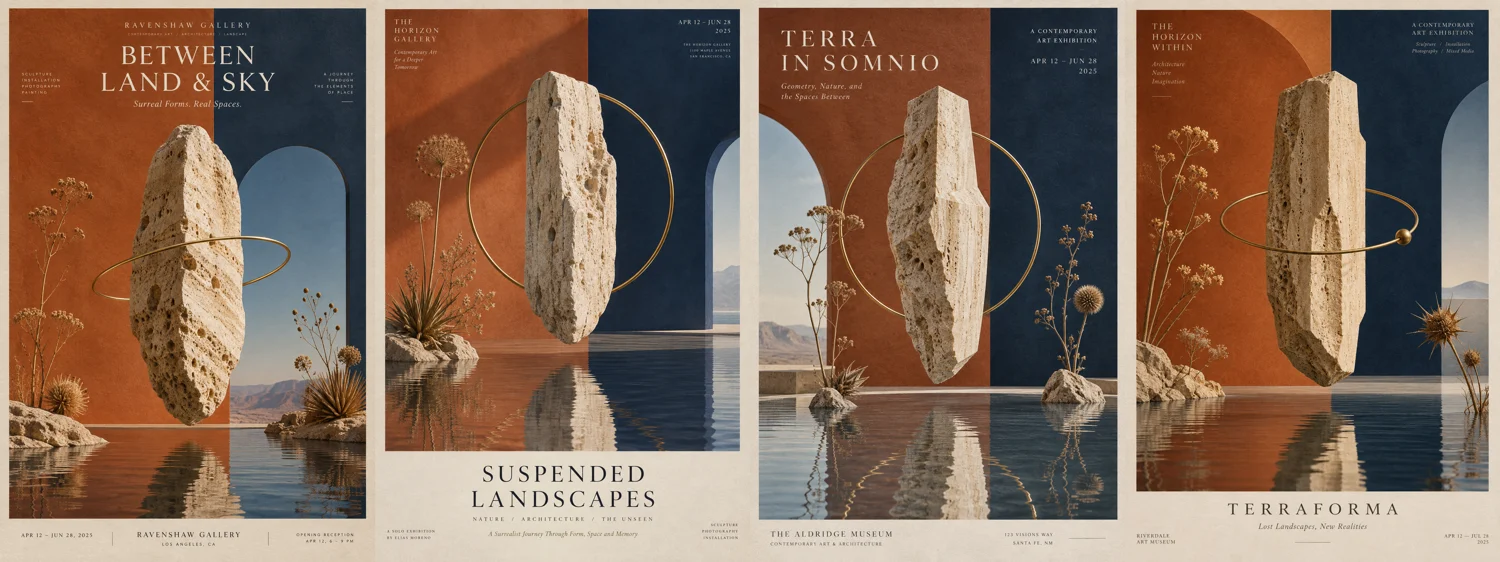

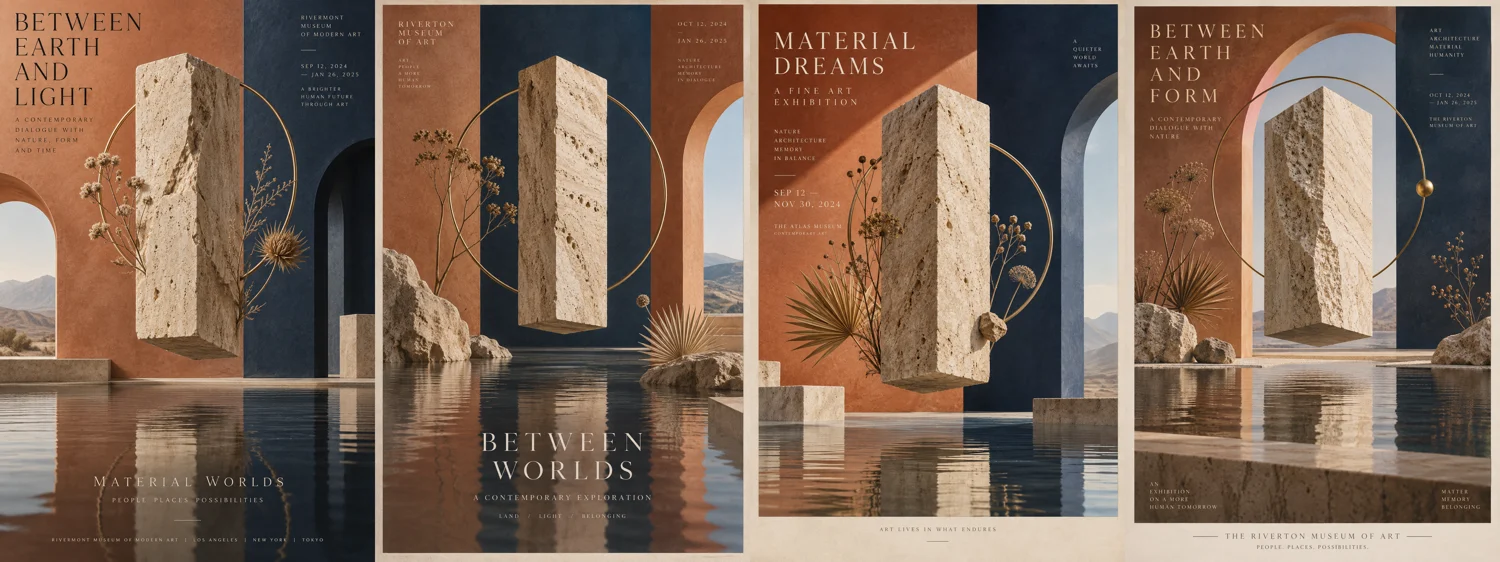
In the surrealist poster test, the primary divergence appeared in how each model constructed spatial perspective behind the subject
Flare interpreted the terracotta and indigo background blocks as a flat graphic backdrop. While effective for graphic print layouts, this created a slight visual separation from the central travertine monolith, which was rendered with realistic three-dimensional lighting.
Sunburst consistently treated the scene as a physical, dimensional environment. The background receded with natural perspective, creating a cohesive spatial relationship between the reflective water surface, the floating stone monolith, and the surrounding gallery walls.
Prompt 2: Warm ambient tinting versus authentic black basalt

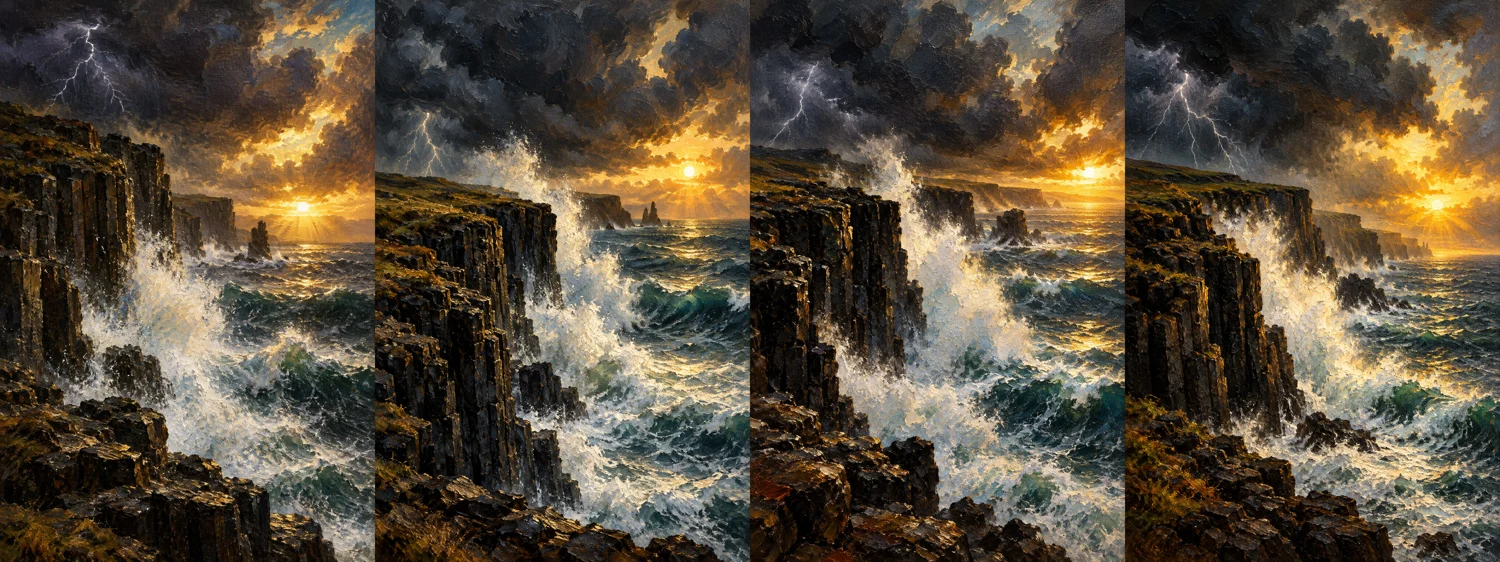

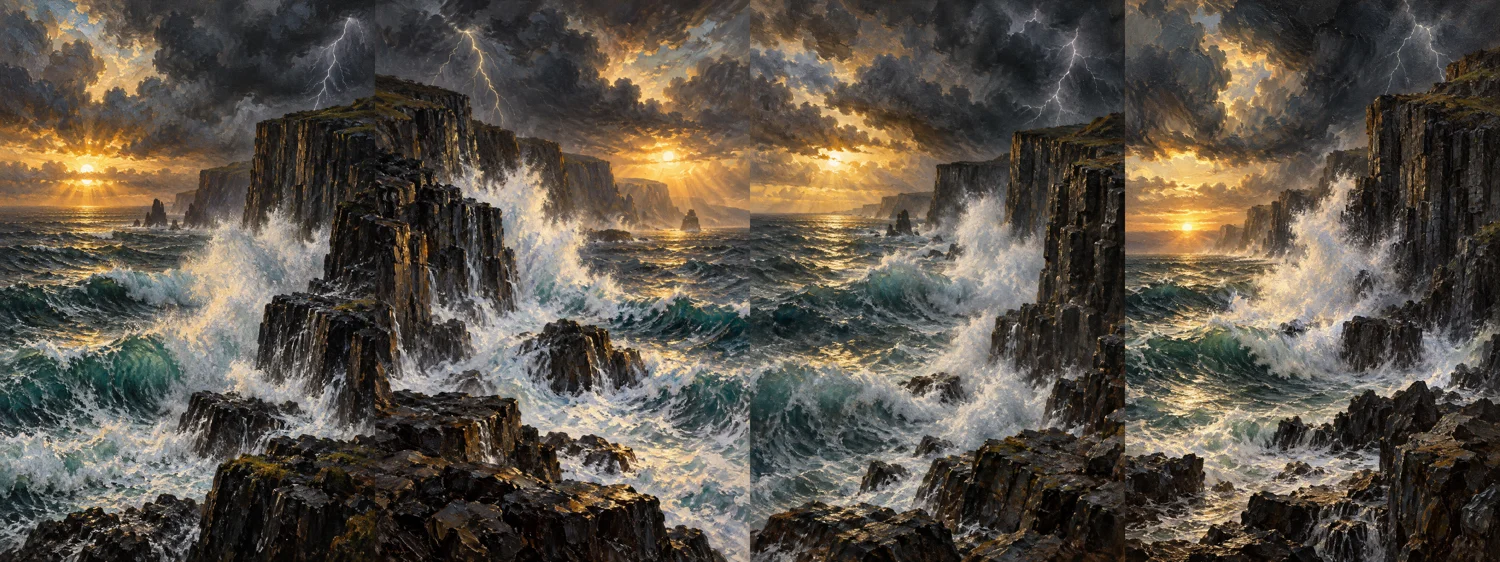
Our oil landscape test revealed an even clearer color handling difference that held steady across all four runs.
When rendering the storm-swept coastal cliffs, Flare consistently gave the rock formations a warm, yellowish-brown cast. The model allowed the warm sunrise light to spill over and alter the base color of the rock face.
Sunburst rendered the cliffs in authentic dark charcoal and deep black basalt tones. It correctly illuminated the sea spray and cloud edges with golden light while keeping the underlying stone neutral and true to life.
Because this exact tonal split occurred across four separate generations, it points to a repeatable architectural bias rather than random seed variance.
Latency observations and single-shot workflow reality
During our live tests, Flare returned finished images noticeably faster than Sunburst. While a two-to-three second difference per image may seem small during exploratory prompting, that latency gap becomes substantial when batch-processing hundreds of visual assets through an automated pipeline.
Crucially, our testing proved that Sunburst does not possess an inherent quality advantage for single-shot generation. Flare matches Sunburst in resolving micro-textures, canvas weave, and intricate brushwork. Choosing between them for standalone assets is a matter of spatial interpretation and color preference, not raw resolution.
Practical verdict: When to deploy Flare versus Sunburst
Based on our benchmark results, here is how creative teams and developers should approach model selection under identical API token pricing:
Use Flare for single-shot generation and high-volume pipelines: If your project requires generating marketing concepts, editorial banners, or bulk prompt variations quickly, Flare offers full visual detail at significantly lower latency.
Use Sunburst when spatial depth and neutral dark materials are critical: If your prompt relies on architectural perspective, dimensional room layouts, or materials like charcoal, basalt, and cool slate that must resist warm ambient color bleed, Sunburst delivers more grounded physical environments.
Reserve Sunburst for multi-turn inpainting workflows: Sunburst is explicitly engineered to preserve visual context across successive conversational edits, making it the preferred engine for fine-grained regional revisions.