Do camera and lens prompts actually change your AI image outputs?

Do camera and lens prompts actually change your AI image outputs? In our tests, it depended on the scene: lens and aperture terms did nothing in a wide city street, but clearly changed depth of field in a tabletop still life.
Many creators add hardware specs to their prompts, like "Shot on Sony A7R V," "35mm f/1.4 lens," or "f/11 aperture." It is not obvious whether models act on them or treat them as decoration.
We ran two experiments in ChatGPT. In each, the scene description and framing stayed the same, and only the camera body, focal length, aperture, shutter speed, and ISO changed.
Experiment 1: New York architectural intersection
For our first test, we selected a complex urban cityscape featuring historic cast-iron facades contrasted against modern glass skyscrapers. We held the composition, street-level perspective, and lighting fixed, changing only the photographic hardware values across four variations.
Test prompts
Prompt 1: Sony ultra-wide 16mm
An architectural photograph of a New York Manhattan intersection at dusk, featuring historic cast-iron brick facades contrasted against sleek glass modern skyscrapers, rain-slicked asphalt reflecting traffic lights and street signs, thin white steam rising from a street manhole cover, classic iron fire escapes on building exteriors, eye-level street perspective, straight-on architectural composition, no people in the scene. Shot on Sony A7R V, 16mm f/2.8 lens, f/11 aperture, ISO 100, 1/60s shutter speed.Prompt 2: Leica standard 35mm
An architectural photograph of a New York Manhattan intersection at dusk, featuring historic cast-iron brick facades contrasted against sleek glass modern skyscrapers, rain-slicked asphalt reflecting traffic lights and street signs, thin white steam rising from a street manhole cover, classic iron fire escapes on building exteriors, eye-level street perspective, straight-on architectural composition, no people in the scene. Shot on Leica M11, 35mm f/1.4 Summilux lens, f/4 aperture, ISO 200, 1/125s shutter speed.Prompt 3: Nikon telephoto 200mm
An architectural photograph of a New York Manhattan intersection at dusk, featuring historic cast-iron brick facades contrasted against sleek glass modern skyscrapers, rain-slicked asphalt reflecting traffic lights and street signs, thin white steam rising from a street manhole cover, classic iron fire escapes on building exteriors, eye-level street perspective, straight-on architectural composition, no people in the scene. Shot on Nikon Z9, 200mm f/2.8 VR lens, f/2.8 aperture, ISO 400, 1/250s shutter speed.Prompt 4: Hasselblad medium format 80mm
An architectural photograph of a New York Manhattan intersection at dusk, featuring historic cast-iron brick facades contrasted against sleek glass modern skyscrapers, rain-slicked asphalt reflecting traffic lights and street signs, thin white steam rising from a street manhole cover, classic iron fire escapes on building exteriors, eye-level street perspective, straight-on architectural composition, no people in the scene. Shot on Hasselblad H6D-100c, 80mm f/2.8 lens, f/8 aperture, ISO 64, 1/30s shutter speed.Experiment 1 results: No observable optical shift
Across four runs of each prompt, we saw no meaningful difference between the four camera setups.
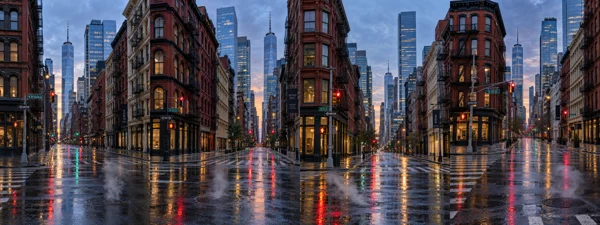
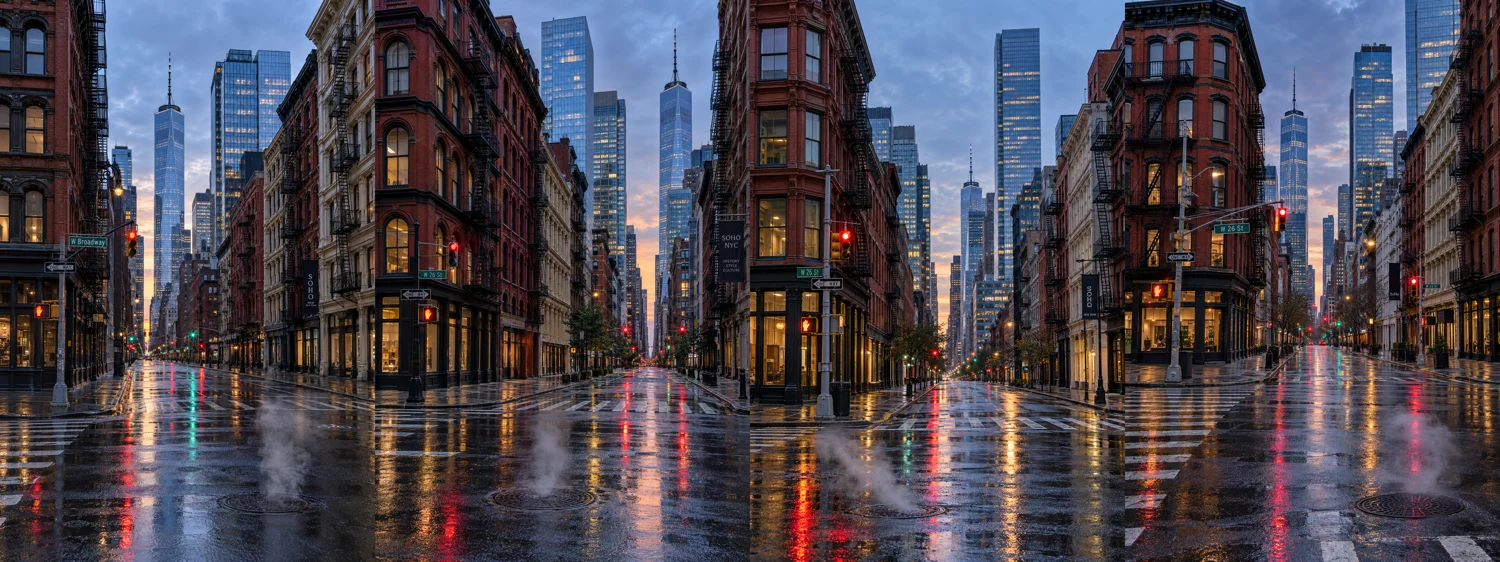
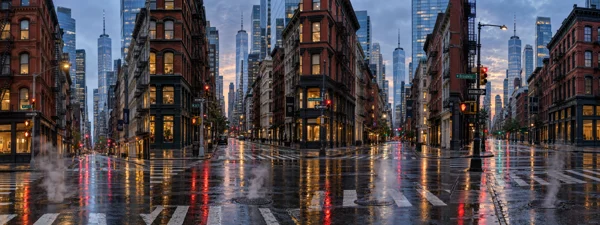
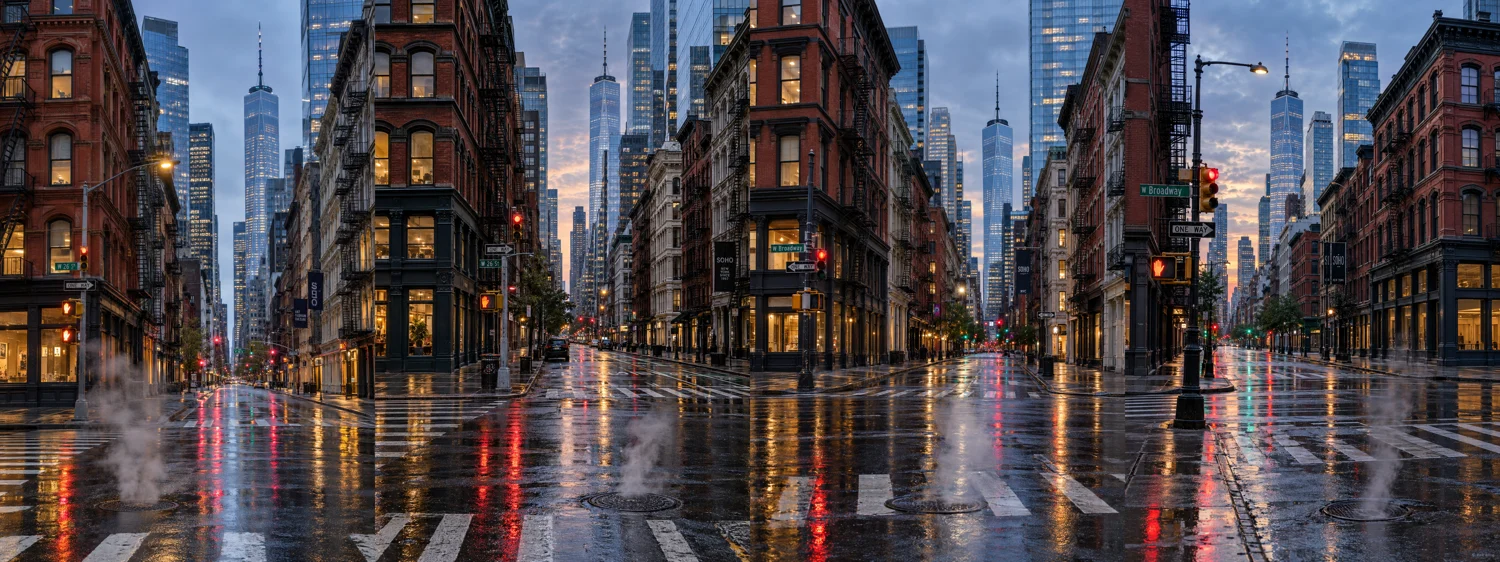
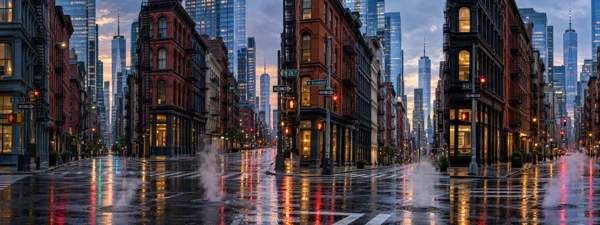
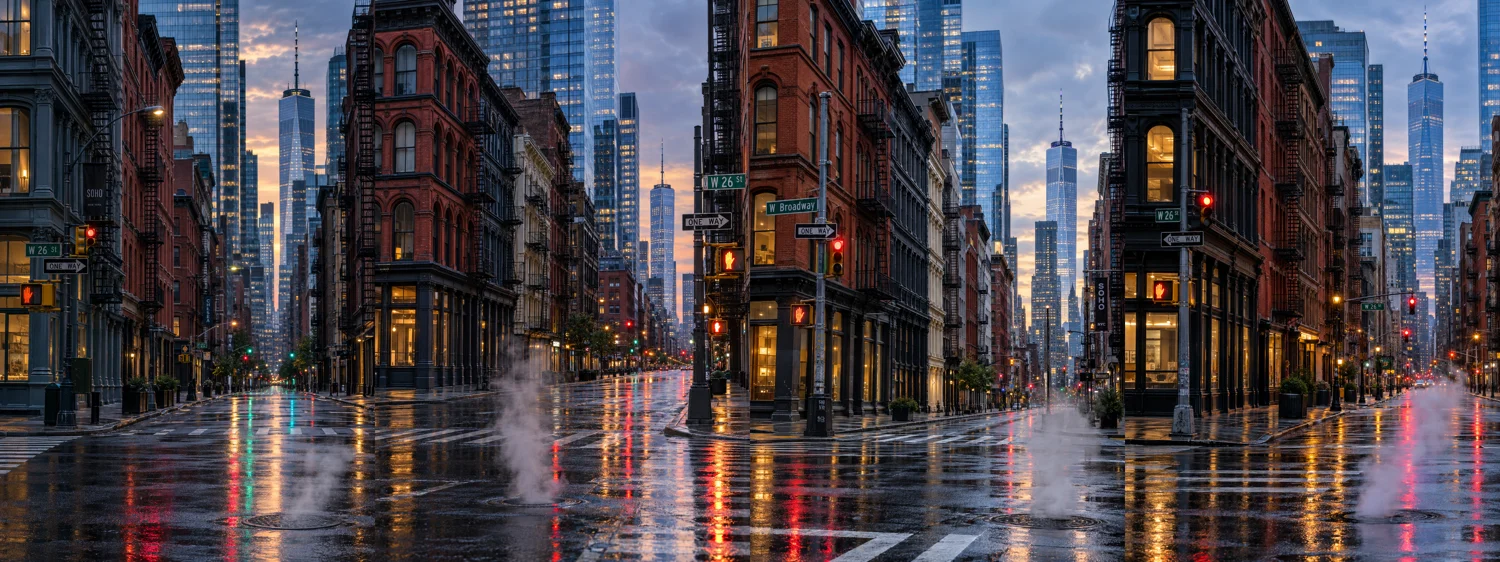
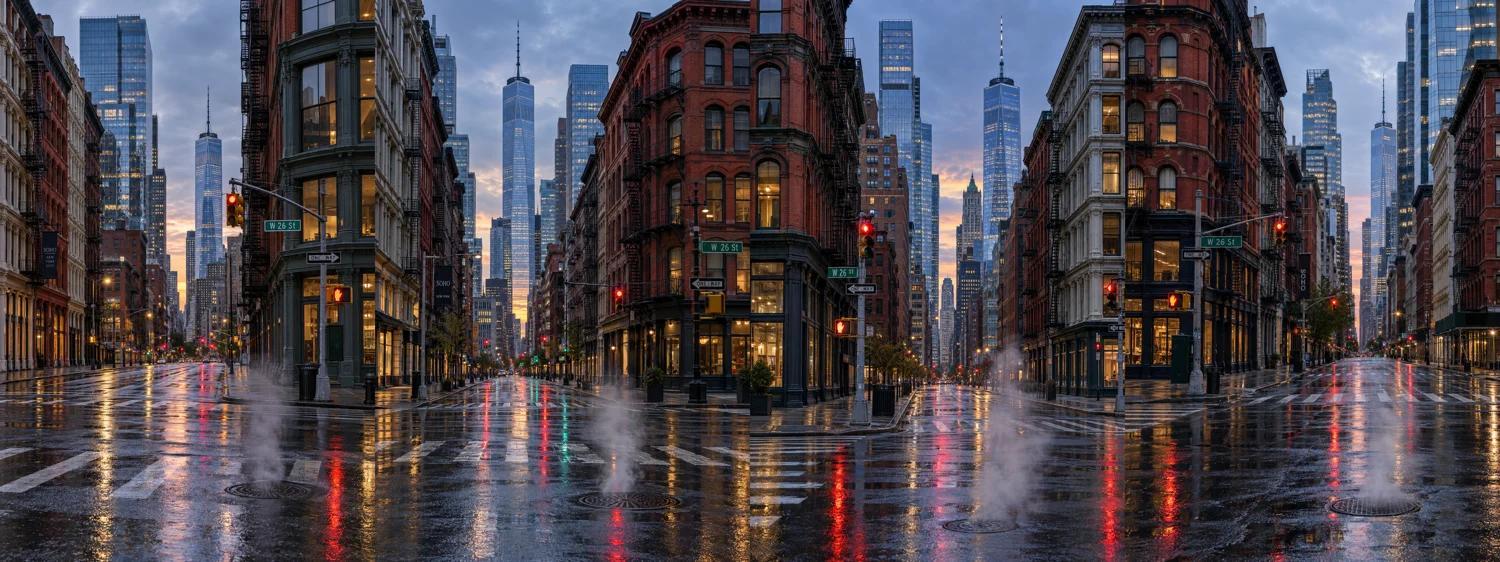
Despite explicitly requesting a 16mm ultra-wide lens, the field of view did not widen, nor did vertical lines show barrel distortion. Similarly, specifying a 200mm telephoto lens failed to compress background buildings or create telephoto cropping.
Experiment 2: Tabletop still life in an antique study
Our cityscape results suggested that wide scenes with uniform spatial depth make focal shifts difficult for models to map.
To test this hypothesis, we set up a second experiment around a tabletop macro subject with distinct depth layers: a vintage brass pocket watch on an aged oak table, with stacked leather books and a glowing desk lamp in the background.
Test prompts
Prompt 1: 100mm macro lens with wide f/2.8 aperture
A still life photograph of a vintage mechanical brass pocket watch resting on an aged dark oak wooden table in an antique library, with stacked leather-bound books and a warm glowing desk lamp in the background, eye-level tabletop perspective, centered composition, no people in the scene. Shot on Canon EOS R5, 100mm f/2.8 Macro lens, f/2.8 aperture, ISO 100, 1/125s shutter speed.Prompt 2: 16mm ultra-wide lens with narrow f/16 aperture
A still life photograph of a vintage mechanical brass pocket watch resting on an aged dark oak wooden table in an antique library, with stacked leather-bound books and a warm glowing desk lamp in the background, eye-level tabletop perspective, centered composition, no people in the scene. Shot on Sony A7R V, 16mm f/2.8 lens, f/16 aperture, ISO 100, 1/30s shutter speed.Prompt 3: 35mm analog film camera with Portra 400 film stock
A still life photograph of a vintage mechanical brass pocket watch resting on an aged dark oak wooden table in an antique library, with stacked leather-bound books and a warm glowing desk lamp in the background, eye-level tabletop perspective, centered composition, no people in the scene. Shot on Leica M6 35mm film camera, 35mm f/1.4 lens, f/4 aperture, Kodak Portra 400 film stock.Experiment 2 results: Clear optical separation
In the tabletop still life, the outputs differed clearly. The three prompts produced distinct variations in depth of field, background roll-off, and highlight transitions.
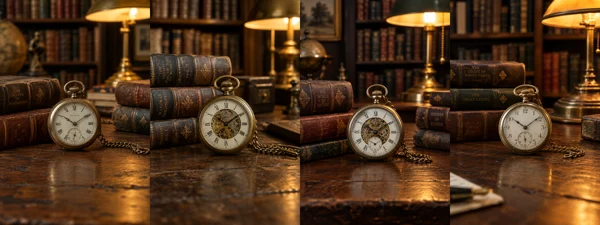
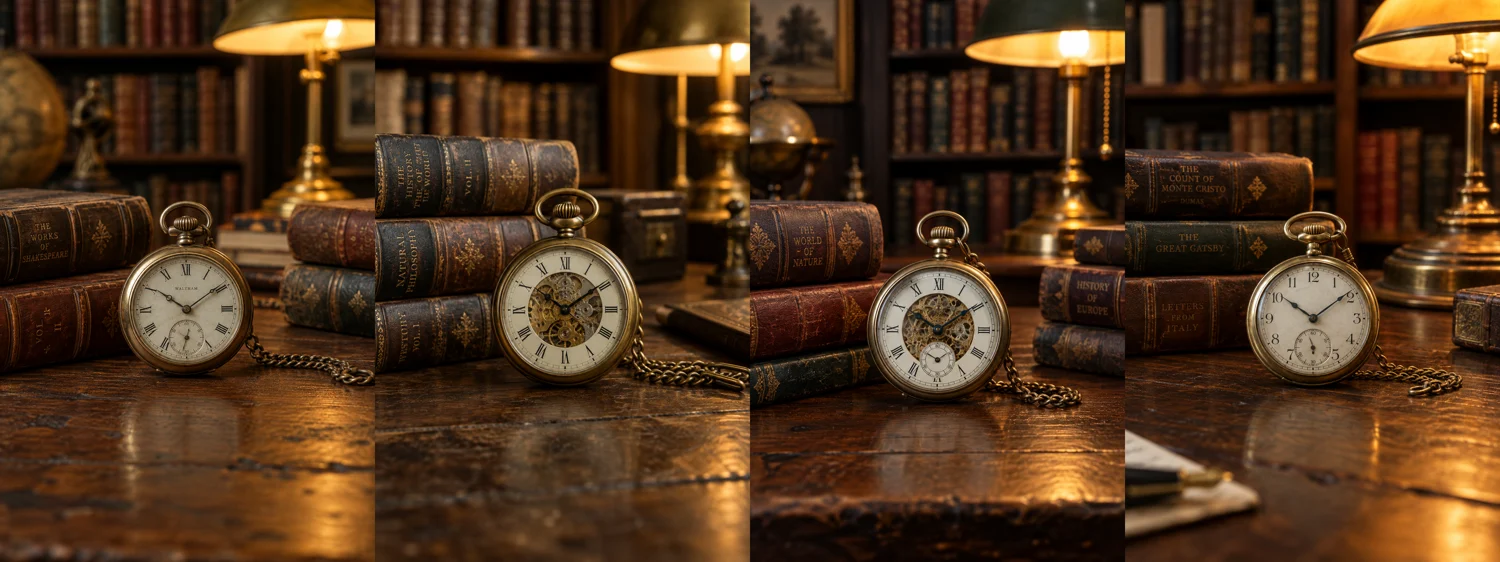
Prompt 1 rendered a shallow depth of field. Focus locked sharply onto the pocket watch face and oak wood grain, while the desk lamp and bookshelves dissolved into smooth background blur.
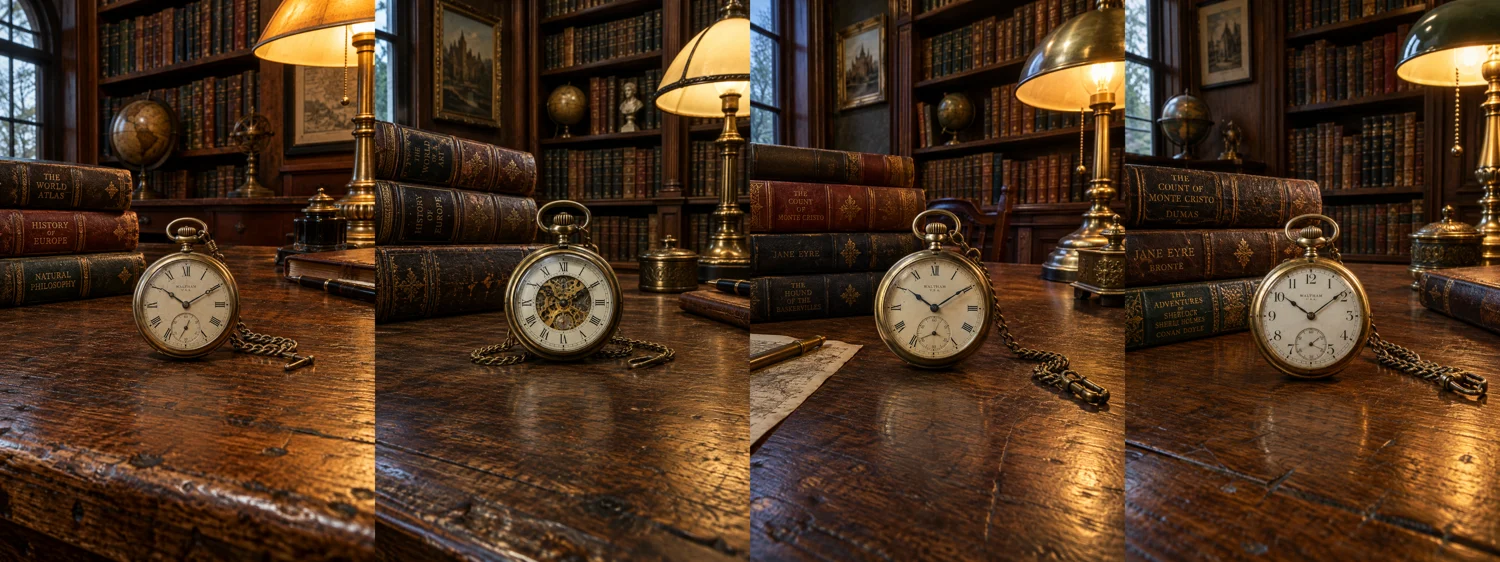
Prompt 2 accurately reflected the narrow f/16 aperture by applying deep pan-focus. Every object from the foreground dial to the background books remained crisp. However, removing optical blur gave the overall render a flatter, slightly illustrative look.
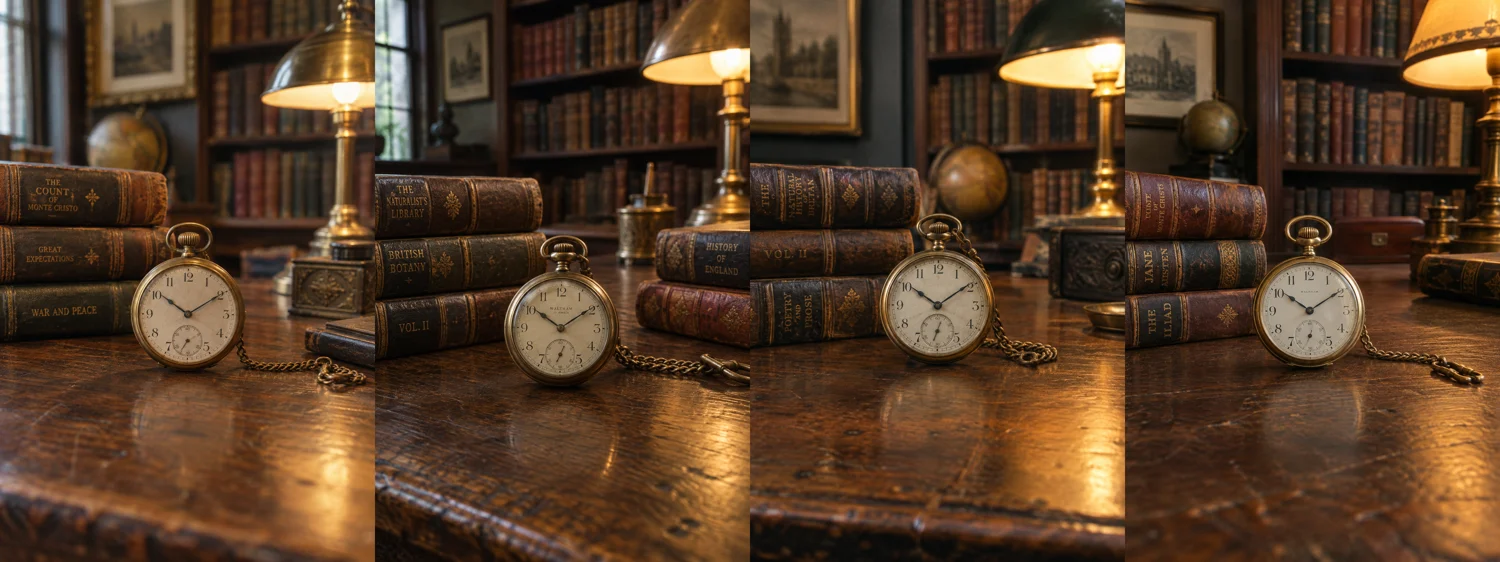
Prompt 3 sat between the first two prompts. The background remained readable but secondary. Highlight transitions across the polished brass watch softened, yielding a natural analog film texture.
Why the scene type might matter
Why did camera specifications produce zero optical change in the cityscape, yet create distinct physical differences in the still life setup?
Our guess: in a street scene, the many objects in the prompt (skyscrapers, asphalt, steam, fire escapes, traffic lights) outweigh the camera specs at the end. We have not verified this, but it matches what the still life test showed.
A still life, by contrast, has a clear foreground subject and a distant background, which may give the model somewhere to apply focal length and aperture.
When lens tags help
From these two tests:
Use camera and aperture tags for close-up and portrait work: When your scene features a clear foreground subject, specifying a "100mm macro lens" or "f/2.8 aperture" controlled background bokeh and subject separation in our still life test.
Do not rely on lens tags to force wide perspective in landscapes: Specifying a "16mm wide-angle lens" will not force a landscape scene to widen if the text describes a full street layout. To change framing in wide scenes, use explicit compositional terms like "extreme wide-angle establishing shot" or "distant aerial perspective."
Treat camera brand names as style hints at most: In our cityscape test, "Leica" and "Hasselblad" did not change the image. They may nudge the overall look in other scenes, but we did not see it here.
These results come from four images per prompt in ChatGPT, and other models may handle camera terms differently. For another test of what does and does not change an output, see Does assigning a persona actually change your AI image prompts?