Should your AI image prompts be vague or ultra-specific?

Should your AI image prompts be vague or ultra-specific? We tested both on the same interior concept, a sculptural lounge chair in a living room. In our runs, the vague prompt gave more variety and the specific prompt gave more consistency, so the right choice depends on where you are in a project.
Short prompts leave the model room to interpret, while detailed prompts pin down every material, light angle, and lens. The first is usually praised for surprising forms, the second for repeatable results.
How we set up the comparison
We chose architectural furniture and interior design as our test subject because it requires both distinct geometric forms and controlled spatial lighting. We ran each prompt four times in ChatGPT and Gemini.
Test prompts
Prompt A: Vague conceptual prompt
A sculptural lounge chair inside a futuristic sustainable home with natural lighting, architectural photography.Prompt B: Ultra-specific controlled prompt
A parametric curved lounge chair made of steamed bent walnut wood and cream bouclé fabric, positioned in the center of a brutalist concrete living room with floor-to-ceiling glass windows. Low-angle late afternoon sunlight streams in from the right, casting sharp geometric linear shadows across polished micro-cement floors. In the background, a minimalist indoor olive tree rests in a raw terracotta pot. Shot on a 50mm architectural lens, eye-level perspective, crisp focus, neutral RAW color grading.What each prompt produced
The two prompts behaved differently in composition, materials, and mood.
Vague prompt results: High compositional variance with subtle baseline anchors
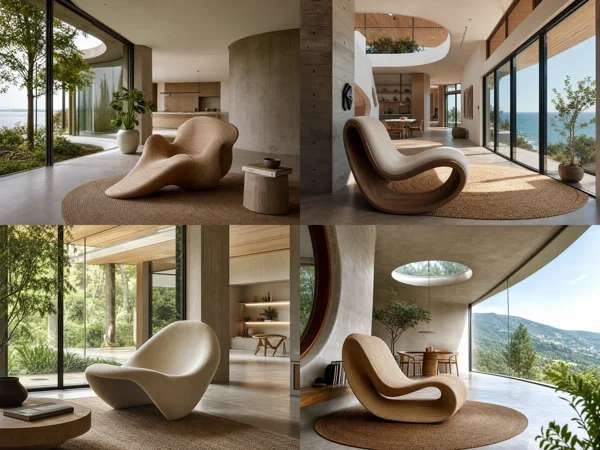
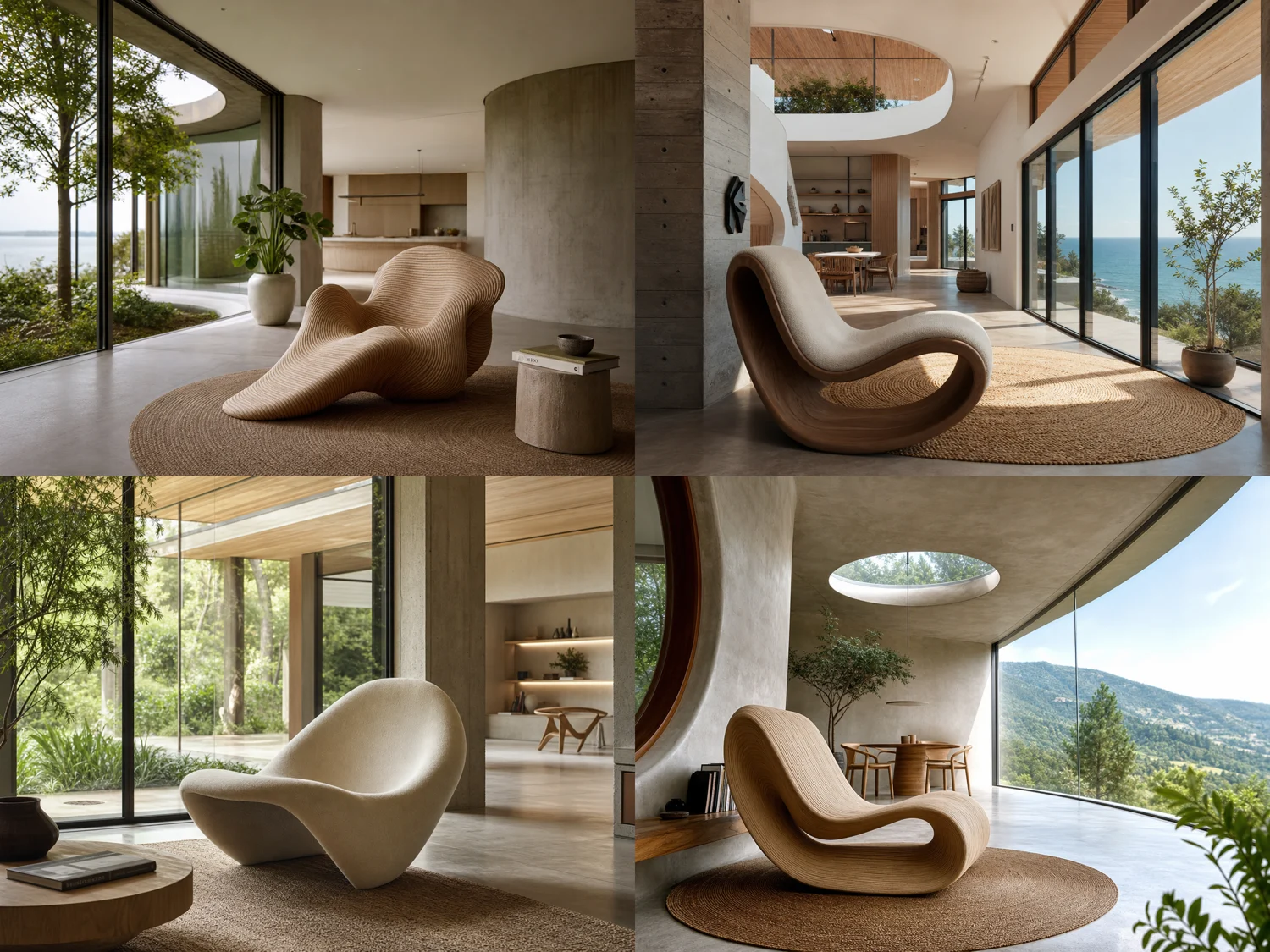
Prompt A produced wide visual variety across generations. The silhouette of the lounge chair, camera perspective, and room geometry shifted with every run. This variability surfaced unexpected, sculpturally compelling furniture forms that were not explicitly planned.
Despite the structural shifts, the overall palette remained cohesive. Polished stone floors, off-white surfaces, and warm neutral tones appeared across all outputs. Broad phrases such as "natural lighting" and "futuristic sustainable home" functioned as strong conceptual anchors, establishing a believable interior mood without rigid constraints.
Ultra-specific prompt results: Consistent across runs
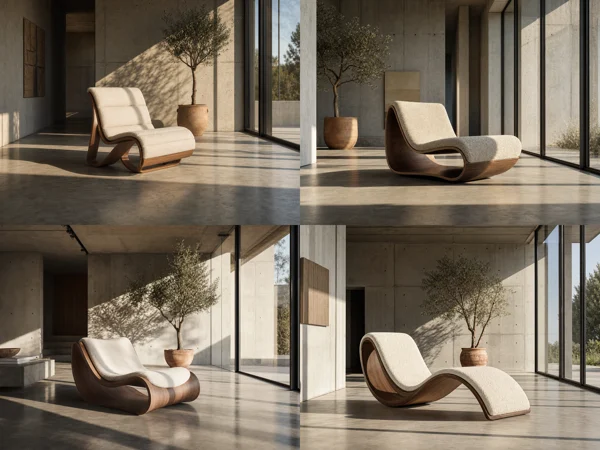
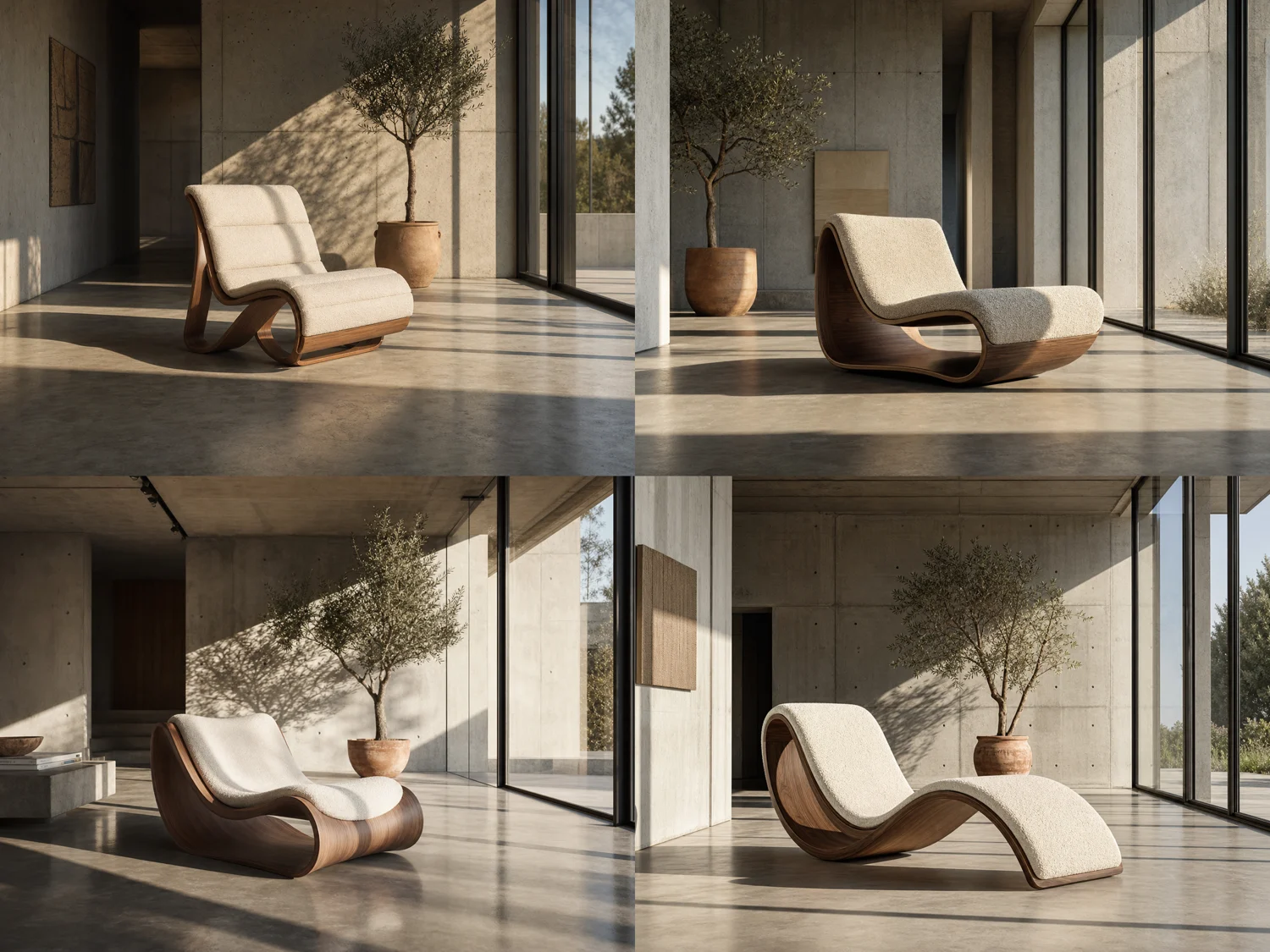
Prompt B yielded four images that looked like a cohesive design set from the same architecture studio. The parametric constraint stabilized the chair's geometry, while terms like "steamed bent walnut wood" and "cream bouclé fabric" rendered with consistent surface accuracy. The direction of the late-afternoon sunlight casting linear shadows across the micro-cement floor was reliably preserved.
The results also looked like editorial architecture photography, with crisp surfaces and controlled depth of field. We did not test the lens terms on their own, so we cannot say how much of that came from "50mm architectural lens" and "crisp focus." Our camera and lens test looks at that question directly.
Conversational editability
We also tested post-generation adjustments by prompting the model to remove background objects through conversational text commands.
Both open-ended and ultra-specific outputs handled conversational object removal cleanly. Target elements were removed without corrupting adjacent textures or shifting the perspective of the room. In our editing rounds, the length of the original prompt made no difference to how well local edits worked.
When to use each approach
Neither method is universally superior. The right structure depends on your current phase in the creative workflow.
Use open-ended prompts for:
Early ideation and moodboarding: Exploring multiple aesthetic directions when you do not yet have a rigid visual reference.
Form discovery: Allowing the model to propose novel silhouettes, layouts, and lighting dynamics.
Concept alignment: Presenting diverse visual territories to stakeholders before locking down specific parameters.
Use ultra-specific prompts for:
Brand and project compliance: Matching established client materials, color palettes, or spatial layouts.
Series consistency: Ensuring multiple campaign assets share identical focal lengths, color grades, and lighting angles.
Photographic precision: Controlling shadow sharpness, depth of field, and tactile surface finishes.
Using both in one project
The two approaches work best in sequence:
Explore with open prompts: Start with a concise, theme-level prompt to generate five to ten divergent directions. Identify the strongest silhouette or spatial mood.
Define exact visual parameters: Extract the successful attributes from your reference image. Add explicit descriptors for materials, directional lighting, background objects, and camera optics.
Refine and standardize: Reuse the detailed prompt as the baseline for final assets, so the whole set shares the same styling.
These results come from four runs per prompt in ChatGPT and Gemini, and models change often. If you are deciding how to phrase the details, we also compared comma lists and full sentences.